


Red Stag Fulfillment Alternatives
Top posts


Red Stag Fulfillment has carved out a solid name handling large, heavy, high-value shipments - industrial equipment, sporting goods, oversized retail items where careful handling and accuracy guarantees justify the premium.
But if your catalog runs 500 or 5,000 SKUs of lightweight, standard-size products, that model doesn't fit your operational reality. Finding the right 3PL alternatives to Red Stag means evaluating providers built for parcel velocity, SKU flexibility, and ecommerce-native connections.
Below, let's look at why Red Stag's specialization creates this mismatch, what to test in a replacement, and six providers worth a closer look.
Where Red Stag Fulfillment Fits Best
Red Stag operates two U.S. fulfillment centers in Knoxville, TN, and Salt Lake City, UT, and specializes in items that weigh over 10 lbs, run bulky or fragile, and carry high per-unit value.
Their pricing model reflects this focus: storage rates, receiving fees, and per-order charges are calibrated around lower-velocity, higher-margin SKUs where their accuracy guarantee (they reimburse 100% on mis-ships and damaged items) delivers real financial protection.
That model makes little sense for high-SKU, small-parcel DTC brands. When your operation ships hundreds of orders daily across hundreds of product variants, your priorities shift toward per-unit cost control, fast SKU setup, carrier rate shopping, and clean inventory reconciliation across channels.
Those priorities point toward a fundamentally different class of fulfillment providers for small parcels. Let’s look at several alternatives and how they compare with Red Stag.
At-a-Glance Comparison of Red Stag Fulfillment Competitors
Top Red Stag Fulfillment Alternatives for High-SKU, Small-Parcel Brands
Ops Engine
Ops Engine runs its own fulfillment warehouse in Valencia, California, serving DTC and omnichannel brands in apparel, beauty, supplements, CPG, pet, baby, toys, and books.

It positions itself as your warehouse department rather than as a vendor that runs every account through a single template. Pick paths, packing standards, and reporting get built around your catalog.
The model centers on catalogs with a wide variety of items shipped in small packages.
Apparel experience matters here. A 60-product line becomes 500 active SKUs once you add size and color. That same variant density shows up in supplements, beauty sets, and pet products, and it strains receiving, storage, and pick accuracy long before it becomes a space problem.
Small-parcel fulfillment:
- Orders received by 12 pm PST ship the same day
- Domestic parcels move via USPS, UPS, FedEx, and DHL eCommerce
- Rates negotiated across combined brand volume, not your account alone
- Expedited service where destination and carrier support it
- International orders route through Passport and Zonos, so duties and taxes are collected at checkout
High-SKU capabilities:
Scan-based verification during pick-and-pack prevents a 400-SKU catalog from resulting in mispicks of visually similar items.
Receiving supports that accuracy. Units arrive individually labeled, with carton contents identified, and Ops Engine handles in-house labeling when a manufacturer cannot. Receiving finishes in 1 to 2 business days from the starting point, but also depends on the size of the delivery. The more proactive notice and information is provided by the client, the better the turnaround time.
The WMS carries custom workflows, inventory management, and reporting. A client portal gives 24/7 visibility into orders, shipping, and performance. That visibility affects how much cash you tie up in stock.
Fulfillment network:
One facility in Valencia, near Los Angeles, supporting nationwide fulfillment. West Coast placement covers the western third of the country in one or two ground days and works well for Asia-sourced inventory.
Fulfillment capabilities:
DTC, B2B, and EDI orders are processed by the same operation:
- Kitting, bundling, labeling, light assembly
- Custom packaging, gift messaging, Amazon FBA prep
- Returns received, processed, and updated in the system, so stock reappears as sellable
- Wholesale routing guide compliance: GS1-128, SSCC labels, ASNs
Integrations:
Shopify, Amazon, TikTok Shop, BigCommerce, WooCommerce, Etsy, NetSuite, Wix, Magento, Squarespace, plus B2B and EDI for retail programs. Tracking syncs back to your store automatically.
Other considerations:
No long-term contracts. Most brands operate on monthly terms, with any minimums defined upfront.
The facility is FDA-registered, follows OSHA-aligned safety practices, and maintains alarm monitoring with camera coverage across receiving, storage, and shipping. Brands can add the location to an existing policy or waive inventory coverage.
Best fit: Growing DTC and omnichannel brands with wide, frequently changing catalogs that want a hands-on partner instead of a self-serve platform.
Buske Logistics
Buske is a long-established U.S. 3PL rooted in retail and consumer goods distribution. It supports high-SKU brands selling direct to consumers and into retail accounts from a single inventory pool. Retail compliance depth is handled in-house.

Most large catalogs eventually pick up wholesale accounts. Then you need routing guide compliance, ASNs, and carton labeling done right, because chargebacks from a major retailer can erase the margin on many small parcels.
Buske covers both sides. DTC parcels and retail POs draw from one stock position.
Small-parcel fulfillment:
Ecommerce pick-and-pack runs alongside case and pallet work. The U.S. footprint shortens lanes on both coasts and through the central states, pulling down zone counts on lightweight ground parcels.
Confirm during pricing: how per-pick rates behave when your average order is two light items at high volume. Rate cards built for case picking do not always translate.
High-SKU capabilities:
Buske manages large item counts as standard consumer goods work, including lot-controlled inventory for food and beverage clients. Receiving, put-away, and location control follow documented processes.
Fulfillment network:
Warehouses across multiple U.S. states, so brands can split inventory east and west. For small parcels, that spread matters through zone reduction and shorter ground transit.
Fulfillment capabilities:
DTC parcel, B2B and wholesale distribution, omnichannel order flows, retail compliance labeling, and ASNs. Buske also runs dedicated transportation, useful if you move inbound freight regularly.
Integrations:
EDI for retail partners, plus ecommerce and ERP connectivity. Confirm your specific cart and marketplace stack during scoping.
Other considerations:
This is a traditional 3PL shaped by large consumer goods accounts, not a software-first platform. Set expectations early if you want a polished self-serve dashboard.
Best fit: Brands splitting volume between small-parcel DTC and retail wholesale, both under one roof.
Jay Group
Jay Group is a family-owned provider with facilities in Pennsylvania and Nevada. It earns a spot on assembly work, not warehouse count. Kitting, bundling, retail display builds, and specialty packaging are long-running parts of the business.
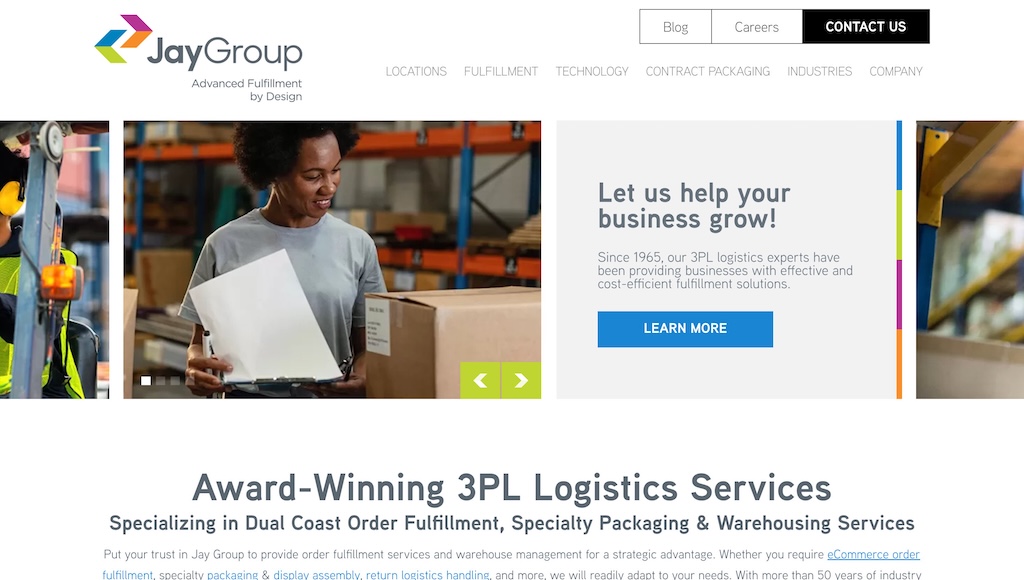
Plenty of 3PLs quote kitting as a project. Jay Group treats it as standard production.
If your catalog spawns new kits every quarter, or your SKU count grows through gift sets and bundles, that matters more than another node on a map.
Small-parcel fulfillment:
DTC parcel volume is a core service line. The Pennsylvania and Nevada pairing reaches most U.S. consumers within two ground days without stocking at five facilities, thereby keeping inventory concentrated and simplifying forecasting.
High-SKU capabilities:
Jay Group runs Manhattan Associates WMS, enterprise software handling large item counts, lot control, and directed picking. That is unusual at this size.
The combination is the point: enterprise inventory control with a service model where someone who knows your account picks up the phone.
Fulfillment network:
Two U.S. facilities, one East and one West. Bi-coastal coverage without the inventory fragmentation of a large multi-node network.
Fulfillment capabilities:
DTC fulfillment, wholesale into major retailers, marketplace orders, kitting and bundling, retail display assembly, specialty and custom packaging, and returns.
Integrations:
Ecommerce platforms plus Amazon and Walmart marketplace orders from the same operation, along with EDI for retail accounts.
Other considerations:
Smaller-agency service model. More direct account contact, less self-service tooling than a platform-first provider.
Best fit:
Brands whose SKU growth comes from kits, sets, and retail-ready packaging alongside everyday parcel volume.
ShipBob
ShipBob is a technology-led 3PL with fulfillment centers across the U.S. and internationally. It fits high-SKU brands whose main cost lever is shipping zones, with inventory distribution controlled through self-serve software.
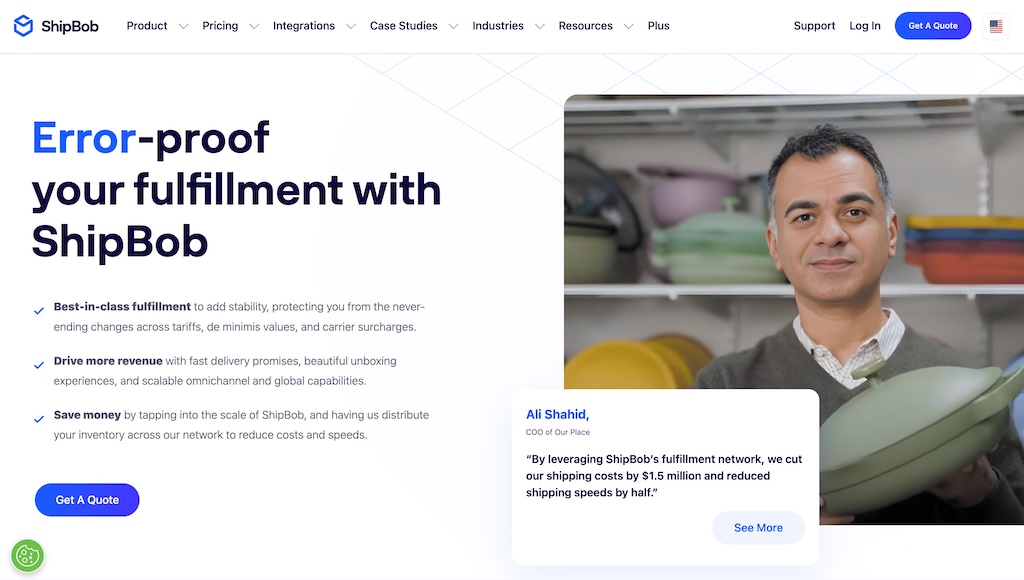
Split inventory across nodes and orders ship from the location nearest the buyer. On lightweight parcels, dropping two or three zones changes per-order cost at volume.
That targets the brand shipping thousands of small packages a month.
Small-parcel fulfillment:
Standard-size ecommerce parcels are the core business. The platform handles carrier rate shopping, order routing rules, and inventory allocation across locations without requiring an account manager to make each change.
High-SKU capabilities:
The dashboard shows real-time inventory by SKU and by location, which is what you need once stock is split across facilities. Reorder alerts and demand data help prevent one node running dry while another sits on excess.
Verify how the platform handles frequent new SKU introductions and custom kit builds if your catalog changes often.
Fulfillment network:
Multiple U.S. locations plus facilities in Canada, the UK, and Europe. International nodes let you test a region without a separate 3PL relationship.
Fulfillment capabilities:
DTC fulfillment, B2B and retail distribution, returns management, custom packaging and inserts, and kitting.
Integrations:
Shopify, Amazon, Walmart, WooCommerce, BigCommerce, Squarespace, Wix, eBay, Etsy, TikTok Shop, and an open API.
Other considerations:
Service depth is the trade-off. ShipBob runs closer to a platform than a hands-on operations team, and brands with unusual packing standards or steady special-project work sometimes find the process rigid.
Best fit: High-SKU brands with national order distribution that value zone reduction and self-serve control over dedicated account handling.
ShipMonk
ShipMonk is an ecommerce 3PL that grew up around subscription boxes and fast-scaling DTC brands. Multi-item and recurring orders are built into the standard workflow, not quoted as custom projects.

Subscription and bundle-heavy catalogs create SKU counts that look scary on paper. One monthly box might pull eight components from eight locations. ShipMonk's operations were designed around that pick profile, so the process already exists.
Small-parcel fulfillment:
Small and mid-size ecommerce parcels are the primary volume. Carrier rate shopping and multi-carrier coverage support standard ground and expedited service.
High-SKU capabilities:
The 3PL platform manages inventory, orders, and warehousing across multiple sales channels from a single dashboard, with SKU-level visibility and low-inventory alerts.
Ask directly about a large SKU migration. Item data quality, barcode standards, and receiving sequence determine how your first 60 days go, and that is where most high-SKU transitions get painful.
Fulfillment network:
Multiple U.S. warehouses plus locations in Canada, the UK, and mainland Europe. Brands can split inventory as volume grows without changing providers.
Fulfillment capabilities:
DTC fulfillment, subscription boxes, kitting and bundling, retail and B2B orders, returns, and custom packaging inserts.
Integrations:
Shopify, Amazon, Walmart, WooCommerce, BigCommerce, Etsy, eBay, TikTok Shop, and Squarespace.
Other considerations:
Pricing covers pick fees, storage, and platform access. Model your real order mix rather than the headline per-order rate, since multi-item subscription orders behave differently from single-item DTC on any per-pick model.
Best fit:
Brands with subscription, bundled, or multi-SKU orders that need kitting handled as everyday production.
Stord
Stord pairs a fulfillment network with its own warehouse, order, and transportation software. It fits high-SKU brands running parcel and retail volume simultaneously, with a single software layer across every node.
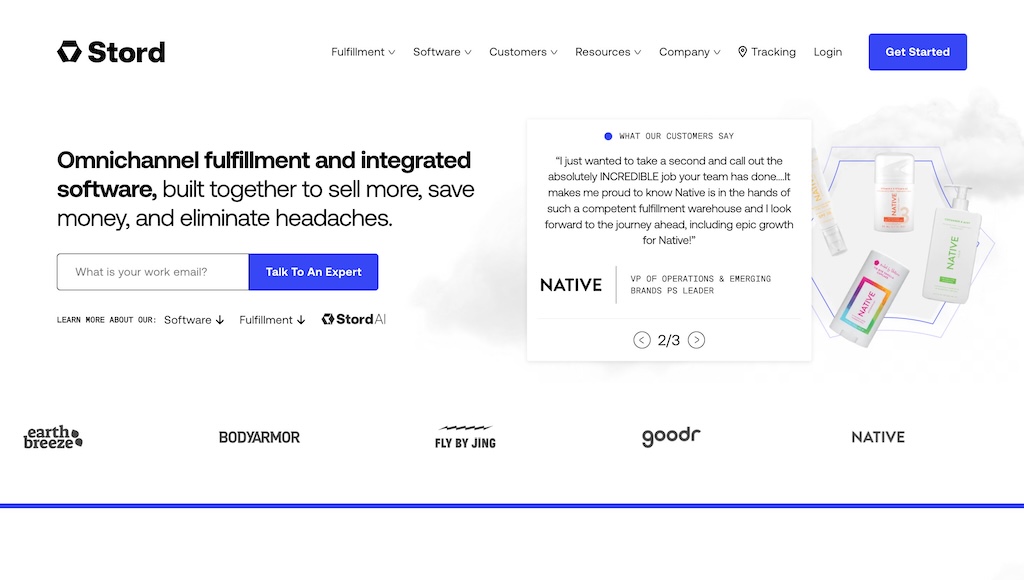
Most brands at scale end up with an OMS in one place, warehouse data in another, and freight rates in a third. Stord runs its own WMS, OMS, and TMS across owned and partner facilities.
One system removes the reconciliation work that eats operations time as SKU counts climb.
Small-parcel fulfillment:
Parcel fulfillment runs alongside retail distribution from the same locations. The transportation layer handles parcel rate shopping and freight, which is useful if you move inbound containers and outbound parcels at similar volumes.
High-SKU capabilities:
Inventory, order, and transportation data are in a single system, so SKU-level positions remain consistent across channels. For a brand selling the same item through DTC, marketplaces, and retail, that prevents overselling.
Fulfillment network:
Owned and partner facilities across the U.S., with added coverage in the UK and the Netherlands after recent acquisitions. Broad U.S. ground coverage supports parcel volume across regions.
Fulfillment capabilities:
B2C parcel, B2B retail distribution, omnichannel order routing, EDI and retail compliance, freight management, and returns.
Integrations:
Shopify, Amazon, NetSuite, EDI for retail accounts, and API access for custom systems.
Other considerations:
Stord targets mid-market and enterprise volume. Platform fees can exceed what an early-growth brand should spend, so check pricing against your actual order counts before the software decides on its own.
Best fit: Mid-market and enterprise brands with complex omnichannel volume that want software and network from one provider.
Match the 3PL to Your Business
No 3PL wins on network size or feature count alone. What matters is whether the model matches how your catalog actually moves. A wide catalog of light items shipping in high order counts puts pressure on a different set of processes than heavy or oversized freight does, and pricing built for one profile rarely works well for the other.
Compare the six providers above on small-parcel rate structure, high-SKU receiving and picking, batch and kitting work, zone coverage, inventory technology, omnichannel handling, and service terms.
Before picking, run your own numbers: order volume, active SKU count, average item weight, destination mix, and the workflows you already rely on.
See more articles


%20(1).jpg)

.png)


