


ShipMonk Alternatives for Brands with Non-Standard Fulfillment Work
Top posts


Automated picking works because it removes decisions. Pick-to-light systems, automated tote destackers, shipping sorters, and order drop-off conveyors all depend on one thing: a fixed, repeatable pick path per SKU. ShipMonk publishes this stack openly, and it's a reasonable setup for stable order profiles.
Some brands need a warehouse where non-standard work is the normal work. That's a model mismatch, not a fixable one.
When people handle kitting and bundling by hand, the process can be much more consistent than an automated pick line. That difference often shows up in the error rate, particularly when each build has different requirements.
This article compares ShipMonk alternatives that handle non-standard fulfillment and how their orders are built, checked, and packed on the floor.
What to Look for in a ShipMonk Alternative for Kitting-Heavy Work
Four things really set a kitting-focused 3PL apart from one that simply offers kitting as a service. Here’s what to look for and what to ask about each one.
1. Documented Kitting Capability
Look for a named kitting and assembly page that describes the build process itself: bill-of-materials assembly, batch builds versus on-demand builds, and where components stage before assembly starts. If kitting appears as bullet point 9 on a general services list, it's a side job, not a specialty.
2. How SOP Changes Get Handled
Ask a direct question: if you send a build change on a Tuesday morning, when does the floor start following it? Then ask who does the building. A dedicated kitting team gives a different answer than general pickers pulled off pick-pack-ship whenever a project lands on their desk.
3. QC Method
Count the inspection checkpoints and ask where they sit inside the build. A single end-of-line check catches packing mistakes. It won't catch a wrong component installed at step two of a six-step kit.
Ask how problems get caught and fixed day to day. That question tells you whether checks happen throughout the build or only at the very end, and whether the warehouse has a process for continuous improvement on the warehouse floor.
4. Receiving Flexibility
Multi-SKU kits rarely arrive complete. One component ships from a domestic printer, another clears customs three weeks later. Ask for published receiving windows, and what happens when components for a single kit land on different schedules. Rigid dock hours create staging problems that turn into shipping delays later on.
Best ShipMonk Alternatives for Complex Kitting and Assembly
OpsEngine
OpsEngine is a Valencia, California 3PL built around assembly-line kitting, with checks at each stage of the build instead of one check at the end.

It works with growing brands across ecommerce and retail and is known for a hands-on approach and a focus on brands with more involved operational needs.
Kitting and added services: assembly-line kitting and bundling, subscription box builds, crowdfunding fulfillment, Amazon FBA prep, pick-and-pack services, plus custom packaging and gift messaging.
Technology: a WMS with real-time inventory data and a 24/7 client portal. Wide list of platform connections, including Shopify, WooCommerce, and Amazon.
Facility and scale: 30,000 sq. ft. facility in Valencia, CA with 4 dock doors. Receiving generally takes 1–2 business days, with most shipments completed in under 6 hours.
Terms: Month-to-month. No long-term commitment or minimum order commitment.
Best for: brands whose kit contents or build instructions shift from cycle to cycle, and who want people doing the assembly rather than a reprogrammed pick path.
Handled
Handled is a Riverside, California 3PL focused on supporting growing ecommerce brands. The company takes a hands-on approach to fulfillment and emphasizes flexibility and close collaboration with its clients.
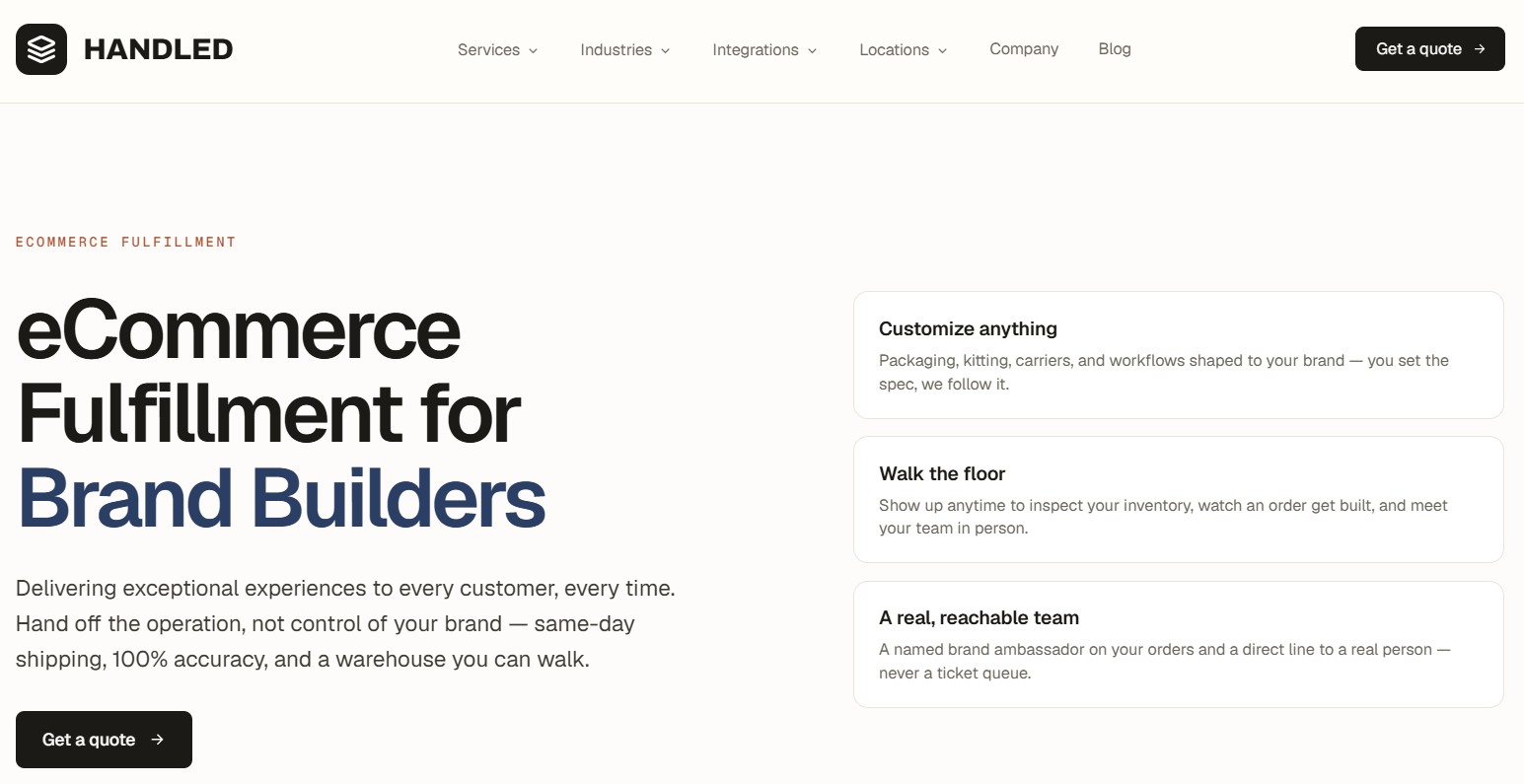
Kitting and added services: custom bundles and multi-SKU kits built to spec, subscription assembly with per-subscriber variants, branded packaging and inserts, plus Amazon-ready labeling and prep.
Technology: Shopify, Amazon, TikTok Shop, Rithum, and ShipStation, etc., with API and custom integration options also available.
Facility and scale: 2 U.S. facilities in Riverside, CA and Carlstadt, NJ. Receiving hours are Monday–Friday, 9 a.m.–4 p.m. local time. Shipments of 8+ pallets require a delivery window scheduled at least 48 hours in advance.
Terms: Usage-based pricing. No minimums. Storage, fulfillment, and shipping charged separately.
Best for: brands that want to physically check builds and inventory in person rather than rely on a dashboard and hope it's right.
Motivational Fulfillment & Logistics
Motivational Fulfillment & Logistics is a Southern California 3PL serving ecommerce, retail, and consumer brands. It has experience working with brands that need a flexible partner as their operations grow.
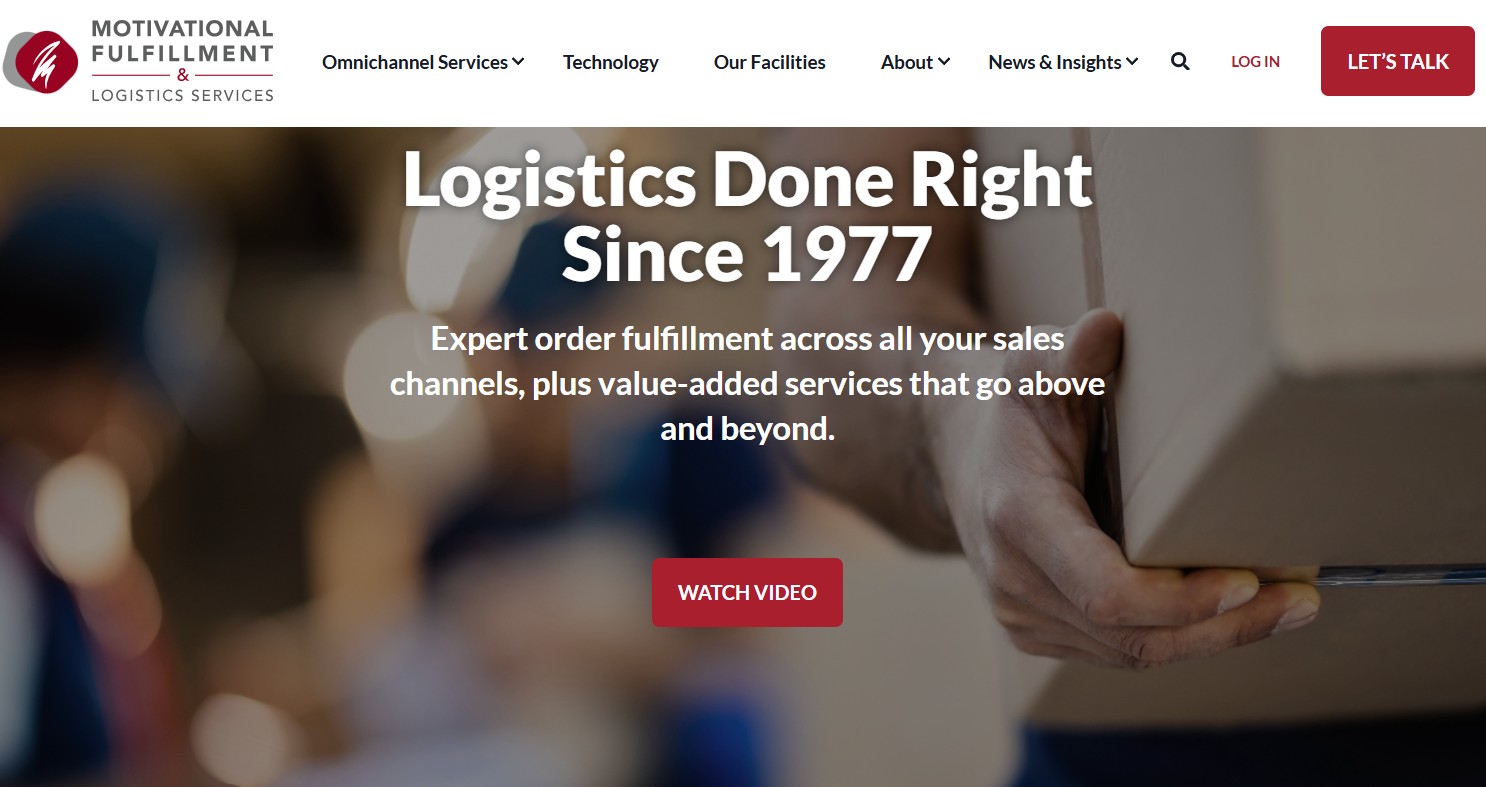
Before committing, confirm the current corporate structure, as recent coverage mentions a merger with QuickBox.
Kitting and added services: POP displays and price ticketing, custom kitting and product assembly, reboxing and refurbishing, plus retail compliance and EDI routing for retail partners.
Technology: Proprietary WMS, Logistica, with integrations across major EDI providers and e-commerce platforms.
Facility and scale: Motivational has merged with QuickBox into a combined ~3.1M sq. ft. platform. Reports 758K+ consumer orders shipped daily. Individual sites have substantial dock capacity, including 120 dock doors at Mountain Avenue, 102 at San Antonio Avenue, and 55 at Philadelphia Street.
Terms: Custom quote. Minimums and contract terms not publicly disclosed.
Best for: brands shipping retailer-specific display pack-outs that need real compliance experience, not generic bundling.
AMS Fulfillment
AMS Fulfillment is a long-established U.S. fulfillment company serving ecommerce and retail brands. It operates at a larger scale and works with businesses ranging from emerging brands to established companies.
.jpg)
Kitting and added services: Large-scale kitting and assembly, display builds, repackaging, labeling, branded pack-outs, gift wrapping, product rework, refurbishment, quality inspection, and specialized product handling.
Technology: WAMS, its proprietary warehouse management system, and Ratelogic for shipping rates.
Facility and scale: 1M+ sq. ft. across facilities in California, Delaware, and Pennsylvania. Public facility information includes sites with multiple dock-high and ground-level doors. Its Valencia headquarters, for example, was documented with 18 dock-high and 3 ground-level doors.
Terms: Custom quote. Multiple fee categories. Minimums and contract terms not publicly disclosed.
Best for: higher-volume brands that need at-scale kit and display builds with people still checking non-standard assembly work.
Kase
Kase is a U.S.-based fulfillment and logistics company that combines warehouse operations with technology. The company pairs Fontana with a nearby Pomona location, supporting DTC, wholesale replenishment, and marketplace orders together across a wider network than the other providers here.
.jpg)
Kitting and added services: kitting and bundling, subscription box assembly, and promotional campaign fulfillment, plus branded packaging, gift wrapping, handwritten notes, and custom inserts across its network.
Technology: a proprietary OMS/WMS with real-time inventory visibility, automated EDI order routing, and Shopify, Amazon, and Walmart integrations across the network.
Facility and scale: 5+ fulfillment centers across the U.S., totaling roughly 1M+ sq. ft. Its Northampton, PA facility is 150,975 sq. ft. with 21 dock doors, and Kase reports an average 25.8-hour dock-to-stock time.
Terms: Custom quote. Minimums vary by business. Standard contract terms not publicly disclosed.
Best for: brands running DTC, wholesale, and marketplace orders through one network who want kitting handled as part of that broader mix, not brands whose main need is cycle-to-cycle kit changes or hand-inspected judgment calls.
When ShipMonk's Automated Scale is the Better Choice
If your orders repeat, automation wins on cost per order and speed.
This works well for:
- Stable SKUs
- Kit configurations that hold steady for quarters at a time
- Pick-pack-ship volume in the tens of thousands per month
The system was built for exactly that shape of demand.
Industry coverage notes that ShipMonk operated around 12 owned-and-operated facilities before the San Bernardino closure, dropping to roughly 11 as of mid-2026.
That points to a company narrowing its footprint and pushing volume into larger regional hubs, not one running a handful of mega-sites. Either way, it's a bet on scale and repeatability over case-by-case handling.
A note on ShipMonk: ShipMonk's San Bernardino facility (CA1) closed permanently on June 30, 2026, confirmed by a California WARN notice tied to Bedabox, LLC. Confirm the current facility details on shipmonk.com, since 3PL networks change often.
Why Automated Fulfillment Lines Struggle with Non-Standard Orders
Here's why that setup gets expensive once the work stops repeating:
- Kit contents that change cycle to cycle: Each change means reprogramming the pick path or overriding it by hand, which cancels out the speed advantage the automation was built for in the first place.
- Per-retailer display pack-outs: Each retailer's compliance rules differ. Standardized lines don't absorb that kind of variation well.
- Gift and PR boxes: Presentation is a judgment call. A sorter can't tell you a ribbon is crooked or the tissue paper is torn.
- Hand-inspected orders: By definition, a person has to be the last check, not a conveyor belt.
- SOPs that change mid-month: Automated lines are built to stay stable. Frequent instruction updates turn routine cycles into exception handling, and exception handling is where automated lines slow down the most.
How to Choose a ShipMonk Alternative
Skip the feature comparison and count a single number instead: what share of your monthly orders require a step beyond pick, pack, and ship?
Work through these:
- Manual assembly: What percentage of orders need a build before they can ship?
- Change frequency: Weekly or monthly kit and SOP changes point toward a manual model. Quarterly or less means automation still works.
- Retail pack-outs: Any retailer-specific display or compliance packing at all shifts the answer toward manual.
- Hand inspection: Gifting, PR, and unboxing-sensitive brands need a person at the final check.
- Variable extras: Inserts, seasonal gift boxes, influencer kits, anything that doesn't repeat cycle to cycle.
If less than 10% of your orders involve non-standard work, an automated 3PL will probably do the job well and cost less per order. Once that number gets above 30%, though, the extra handling costs more. You’re paying for an automated setup while still relying on people to handle work the system wasn’t designed for.
As that share grows, it makes more sense to work with a 3PL where kitting and manual handling are part of the daily operation, not something the team has to squeeze in around the automated workflow.
If you’re still figuring out what type of 3PL fits your operation, start with how your orders actually look rather than getting stuck comparing feature lists.
And if you want to see what that could look like for your order mix, reach out for a kitting quote.
Conclusion
ShipMonk fits brands with repeatable fulfillment. Brands with a different order profile need a different solution. If your kits change from cycle to cycle, if retailers dictate the pack-out, if presentation needs a human eye, or if your SOPs move mid-month, you want a 3PL where that work is routine rather than an exception someone has to log and escalate.
Neither model beats the other in the abstract. Count your non-standard orders, check the fee structure and exit terms of whoever you're considering, and pick the operation built for that number.
See more articles




.png)


